Side project · E-commerce · Live
Marat Art
An online gallery for original paintings, prints and wearable art. Every part of it is mine — the brand, the storefront, the copy, the SEO, the campaigns, and the analytics that say whether any of it worked.
Visit the live site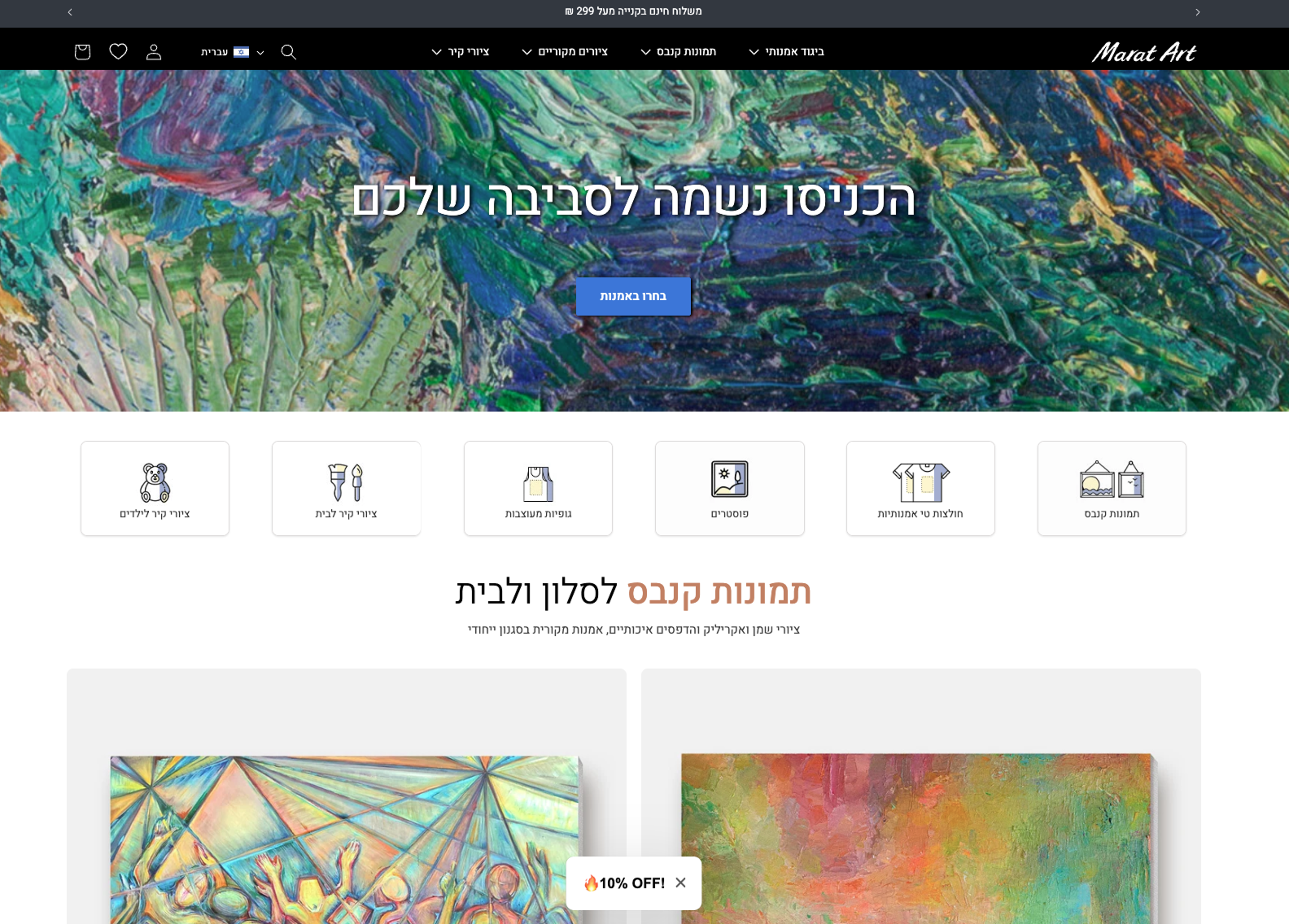
Why this is in the portfolio
Enterprise work ends at handoff. This one doesn’t.
The question I wanted to answer for myself: what do I actually know about the decisions I make, when there’s no PM between me and the outcome?
In a product team I design, hand off, and get told later whether it worked. Here there is no handoff. If the product page doesn’t convert, that’s my product page. If nobody arrives, that’s my SEO. If they arrive and leave, that’s my copy.
It’s the only project where I see the whole line from a design decision to a sale — and the only one where I can’t blame the funnel for anything.
Identity, palette, type, and how the artist’s work is framed.
Shopify build, IA, product templates, responsive behaviour.
Product copy, artist story, blog, and the words that do the selling.
SEO, social, email campaigns, and everything upstream of the site.
Analytics, Search Console, and deciding what the numbers mean.
Scope of the work — ongoing, not a fixed engagement
Decisions
What I considered, what I chose, and what made the difference
A custom build — full control over every pixel, and I can write the front end.
Shopify, theme-level customisation only.
The scarce resource here isn’t design ability, it’s my evenings. Payments, tax, shipping and inventory are solved problems I’d be re-solving badly. Custom would have bought a nicer checkout and cost me the content cadence that actually brings people in.
A designed frame around each piece — brand colour, decorative layout, the site’s own personality.
A near-invisible interface. Neutral ground, generous space, the work carrying all the colour.
This is the inverse of my day job. In enterprise the interface is the product; here it’s the thing standing between someone and a painting. Every element that competes with the artwork is costing a sale.
Standard e-commerce copy — dimensions, medium, price, add to cart.
The story of the piece first, the specification second.
Nobody buys original art on specifications. They buy because something in it landed. The spec closes the sale but it doesn’t open it — and it’s also what search engines have nothing to index.
One catalogue — it’s all his work, browse it however you like.
Four routes in: originals, prints, murals, and wearable art.
The price range spans two orders of magnitude and the intent behind each is completely different — a collector and someone buying a printed t-shirt are not on the same journey. Splitting the entry point means neither has to scroll past the other.
Ongoing
Still being built
Catalogue depth
Hundreds more pieces across the four routes, which will test whether the IA holds at scale or needs a filtering layer it doesn’t currently have.
Story as a surface
The creative process behind individual works, published properly rather than compressed into product copy — the thing that differentiates an artist’s own shop from a print marketplace.
Repeat buyers
Most of the current work is acquisition. The harder question — how someone who bought one print becomes someone who buys a second — hasn’t been designed yet.
Takeaways
What this gives me that enterprise work doesn’t
I see the consequence
A rewritten product description shows up in the numbers within a week. That feedback loop is the single most useful thing about this project, and it’s the one thing a large product org structurally cannot give a designer.
I’ve done the jobs I hand off
Writing the copy, the meta descriptions, the campaign, and then reading the analytics changes how I spec work for other people. I ask for fewer things I now know are expensive.
Restraint as a discipline
Designing something whose job is to disappear is harder than designing something expressive, and it transfers directly — dense enterprise screens fail for the same reason a busy gallery page does.
Commerce is a different clock
Enterprise features ship in quarters. A storefront changes weekly and is never finished. Working in both keeps me honest about which pace a problem actually needs.
What I’d do differently
I built the storefront before I understood who was buying. Six months of analytics would have changed the catalogue split and probably the whole homepage. Next time I’d ship something smaller and let the data pick the structure.